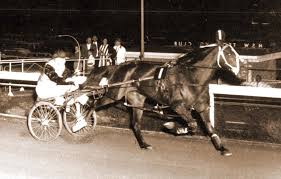
Where Are They Now | Robin Dundee
18 Dec 2025
As Southland readies itself for another G1 Invercargill Cup meeting, it is fitting that one of the feature races on the programme once again carries the name of a mare who has been long in the ground, yet remains central to the region’s harness racing identity. The Robin Dundee Crown has become a familiar and respected fixture on Cup Day, and while the mare herself belongs to another era, her story remains one worth telling, revisiting and preserving.
Robin Dundee was never the biggest horse in the field. Registered at just 14.2 hands, she was diminutive even by the standards of her era. But size was never a limitation. What she lacked in stature, she more than compensated for in courage, constitution and competitiveness, traits that would carry her from Southland to Sydney, and eventually to the biggest stages in North America.
Foaled in 1957, Robin Dundee was bred by Jack Hewitt in what was his first foray into breeding. Her dam Cherry Blossom (by Dillon Hall) had been borrowed from a brother-in-law, and she was sent to the imported American stallion Hal Tryax, a son of the influential Axworthy line. Hal Tryax would only stand in New Zealand for eight seasons before becoming infertile in 1963, but during that brief window he left a disproportionate mark on the breed, topping the New Zealand sires’ list twice and siring champions such as Cardigan Bay and Tactile. Robin Dundee would prove to be one of his toughest and most durable daughters.
She did not race at two, but when she did appear at three, it was immediately apparent that something special had arrived. Under the care of the legendary Jack Walsh, she made her debut at Invercargill and won by 16 lengths, a performance that left no doubt she was well above average. That early promise was quickly confirmed when, driven by Charlie Franks, she captured the New Zealand Oaks at New Brighton, a prestigious and valuable race in that era.
Her early seasons were not without setbacks. After that Oaks victory she went through a patchy run of form, mixing placings with unplaced efforts, before teaming with Robert Cameron to win at Roxborough. A spell followed, and while her record at four and five showed only modest win tallies, her consistency against top-class opposition was beginning to stand out. By the time she reached six, Robin Dundee had matured into a genuine open-class performer.
That season would prove pivotal. She finished second in the New Zealand Cup behind Cardigan Bay, and in her final New Zealand start of the year at Addington, she produced one of the defining performances of her career, coming off a 12-yard handicap to defeat Tactile, Jay Ayr and Cardigan Bay in the same race. It was a victory that underlined her toughness and confirmed she belonged among the elite.
Her campaign then took on an international dimension. She crossed to Australia for the 1964 Inter Dominion series, racing in Melbourne before relocating to Harold Park in Sydney. Although she finished fifth in the Grand Final, the race took a toll. She broke down during the contest, and subsequent examinations revealed a fractured pedal bone and a crack in the navicular bone. For many horses, it would have signalled the end. For Robin Dundee, it was merely another obstacle.
Affectionately known to Walsh as “Little Pet”, she defied expectations and returned to racing in New Zealand during the 1964/65 season, winning five races, placing four times, and finishing third once from just twelve starts. Her consistency and durability saw her finish runner-up to Lordship as the country’s leading stakes earner.
Then came Forbury Park, 1965, and one of the most famous finishes in Inter Dominion history. In the Grand Final, Robin Dundee and Jay Ayr hit the line locked together. The judge initially declared Jay Ayr the winner and ordered a photo, but Walsh immediately protested, adamant it was a dead heat. Officials were forced to reverse their decision, recall both horses, and transfer the sash to Robin Dundee before sending them on a joint victory lap. In front of 15,760 spectators, the only dead heat in an Inter Dominion Grand Final was confirmed, cementing her place in harness racing folklore.
Her brilliance did not end there. At Addington, she equalled the New Zealand mile record of Tactician at 1:59.8, becoming one of just a handful of mares at the time to break the two-minute barrier. The following season she raced 25 times in New Zealand for eight wins, nine seconds and a third, earning £14,855 and finishing as the nation’s leading stakes winner. In Australia, she again proved her class when second to Chamfer’s Star in the Inter Dominion Grand Final at Harold Park, run on a rain-affected track.
Her nine-year-old season was marked by both performance and controversy. After a disagreement with stewards over a driver change, she was scratched from a New Zealand Cup heat, resulting in over £3,100 of betting being refunded by the TAB. Despite the distraction, she continued to race at the top level, driven by Robert Cameron in the remaining heats.
If there was one night that forever tied Robin Dundee’s name to Australian racing history, it came in March 1967. On a warm evening at Harold Park, before 20,287 people, she contested the Craven Filter Miracle Mile. With Cameron in the sulky, she delivered a performance for the ages, stopping the clock at 1:59.0, becoming the first horse to break two minutes for the mile in Australia.
Soon after, Robin Dundee was leased to an American syndicate that included New York trainer Eddie Cobb, with the understanding that she would retire to stud in the United States. She arrived with a record of 34 wins and 60 placings, and earnings exceeding US$150,000, at that time making her the highest-earning mare ever to race out of Australasia. Targeted at the International Series at Yonkers, her campaign was derailed by illness, and after one start she was withdrawn. Walsh remained with her in America for a time before returning home.
Robin Dundee continued racing in North America into her eleventh year, undergoing surgery to remove splint bones before returning to the track. At Roosevelt Raceway she won first-up, and across 35 starts as an eleven-year-old she added US$59,275 to her tally. In a fitting twist of fate, she again chased Cardigan Bay home in the Freehold Special, the race that took him past the million-dollar mark. She retired in 1969 with total earnings of US$292,272.
Her broodmare career began late, but its impact was substantial. Her first foal, Dundee Adios by Adios Butler, went on to stand at stud in both New Zealand and Australia, and is now best remembered through daughters whose families include Courage Under Fire, Advance Attack, Smokey Lonesome, Passion Stride and Mister Rhys. Another daughter, Miss Robin Dundee, became a valuable broodmare in North America before her untimely death while in foal to Albatross.
Perhaps her most influential progeny was Genghis Khan, a colt by Meadow Skipper who developed into one of America’s elite free-for-all pacers, setting a then world record of 1:51.8 and earning close to US$1 million. His influence later filtered back into Australasia, including through his son River Khan, who stood at stud in New South Wales.
After one small test crop in 1982, Genghis Khan served four full stud seasons in North America between 1984 and 1987. From those crops, he produced 179 race winners, including 18 individual $100,000 earners and multiple stakes winners, establishing himself as a genuine source of commercial and on-track success in his country of origin.
One of the more intriguing outcomes from that period was Sogo, winner of the 1991 Great Northern Derby for Roy and Barry Purdon. In a fascinating example of trans-hemispheric breeding foresight, Sogo’s dam had been sent to North America by Noel Taylor to secure a breeding, was foaled there, and then returned to New Zealand.
Following his North American success, Genghis Khan was purchased by Australasian interests and stood at Yirribee, where he further enhanced his reputation. From his time in the southern hemisphere he produced 200 Australian-bred winners and 27 New Zealand-bred winners, including multiple Group One performers. Chief among them was Khans Thunder, winner of the 1994 Victorian Derby and crowned Australian Three-Year-Old Pacer of the Year.
His influence also extended through his daughters, with his damsire legacy including the Group One four-year-old Diamond winner Safin.
While much of the direct maternal influence of Robin Dundee was never fully realised in New Zealand through her daughters, branches of the family have continued to produce in Australia. The most recent stakes-level example is the Australian Pacing Gold Two-Year-Old Fillies Final winner in 2011, Rosa Mach (by Mach Three), a great-great-granddaughter of Robin Dundee. She has two live daughters currently racing in Australia and yet to be bred from.
Beyond the racetrack and breeding barn, Robin Dundee’s legacy lives on through the Robin Dundee Club, a group that has become synonymous with Southland harness racing. Built on friendship, involvement and a genuine love of the sport, the club has long supported initiatives ranging from on-track awards for fillies and mares, to Kids Kartz, Teal Pants and the Southland Harness Awards.
As Southland once again gathers for the Robin Dundee Crown on G1 Invercargill Cup Day, the mare at the centre of it all remains more than a name on a trophy. Robin Dundee was a trailblazer, a record-breaker, and a competitor whose influence spanned continents. Thirty-seven runnings on, her story still stands as one of the finest chapters in Southland harness racing history.