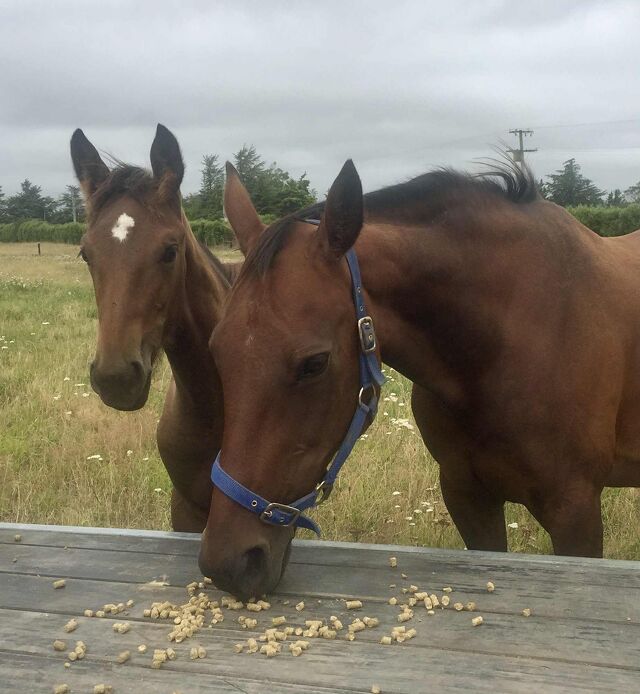
Where Are They Now: Pocaro
23 Oct 2025
Bred by Trevor Casey in partnership with his late friend Gary Allen, the great trotting mare Pocaro (Sundon – Niamey, by Chiola Hanover) was the complete package — blistering speed, beauty, and a streak of stubbornness that made her both unforgettable and unpredictable.
She hailed from one of New Zealand’s most influential trotting families, tracing back to Niamey — the lightly raced mare who would later be crowned the 2019 NZSBA Broodmare of Excellence — and further still to her sister Africa, the matriarch behind Casey’s enduring success in the breed. The Niamey–Africa family has become a cornerstone of the modern New Zealand trotting scene, producing multiple Group 1 winners, juvenile stars, and a depth of black-type performers rarely matched.
Long before Pocaro took shape, Casey’s connection to the family began through Africa, a mare he purchased as a young horse and developed into one of his early flagbearers. Africa won 11 races and over $220,000 before being sold to Australia, where she continued to enhance the line’s reputation. Her full sister Niamey didn’t achieve the same on-track success — she raced just 10 times for a single win — but as a broodmare, she would surpass all expectations.
By the time the NZSBA honoured Niamey as Trotting Broodmare of Excellence, her progeny list already included two Group 1 winners, two additional Group 3 winners, and seven individual black-type performers — among them Pocaro, Sun of Anarchy, Daenerys Targaryen, and Our Daisy Chains. Casey has long credited the bloodline’s blend of toughness and sheer athleticism, traits that came roaring back through Pocaro and her daughters.
Casey, who had bred plenty of trotters before her, admits Pocaro was the one that changed everything. “She was the first one I bred that really stood out,” he says. “But she was very difficult to get going. I gave her to Mark and said, ‘You try her, and if she’s no good, tell me.’ She stayed there — that tells you plenty.”
The mare was broken in by Marie Price, daughter of Eric Ryan, who quickly discovered just how headstrong her young charge could be. Under the care of Mark Purdon and Grant Payne, Pocaro developed into one of the most naturally gifted fillies of her generation — a high-speed trotter whose feet sometimes moved faster than her brain, but when she got things right, she was devastating.
As a three-year-old in 2009, she announced herself with victories in the NZ Trotting Oaks (then G3, now G1), the NZ Hambletonian, and the Harness Jewels 3YO Ruby, which at the time carried Listed status but was later elevated to Group 1. She also set a national 3YO record at Ashburton and was crowned NZ 3YO Filly Trotter of the Year.
Her brilliance was not without heartbreak. In the Northern Trotting Derby, she was cruising to victory under Tony Herlihy before galloping just metres from the post. “She was in front and then she galloped just short of the line — threw away a bloody Group One,” Casey recalls. “But that’s racing. You don’t win until you cross the line trotting, so I just turned the page and moved on.”
Pocaro raced on gamely through her four- and five-year-old seasons against open-class giants like I Can Doosit, Real Deal Yankee and Sundon’s Gift. Though soundness issues limited her later campaigns, she was never disgraced — running I Can Doosit to within a length in the 4 & 5YO Superstars Championship at Addington. By the time she retired, she had raced 42 times for 13 wins, 7 seconds, and 4 thirds, earning $232,773 — a record of class and consistency in one of the strongest trotting eras New Zealand has seen.
When her racing days ended, Pocaro turned her talents to breeding and wasted no time stamping her class. Her very first foal, Missandei (by Angus Hall), won the Harness Jewels 2YO Ruby, emulating her mother’s feat on the same stage. “Chip off the old block,” laughs Casey. “But thankfully, a bit calmer than her mum.”
Missandei’s career was interrupted by a lengthy court case that sidelined her for a year, but she still won nine races and more than $180,000, and is now producing winners of her own, including the 1:55 performer Kyvalley Michael.
The family’s success has flowed through multiple branches. Westeros (by Muscles Yankee) won three races, while Kings Landing (by Muscle Hill) proved a genuine topliner — a nine-time winner of nearly $200,000 and Listed Uncut Gems Trot victor who was also Group 1-placed behind Speeding Spur in the Fred Shaw Memorial. Mercandante (by Majestic Son), later sold, has already bred on — her first foal, The Merc, a Group 1-placed juvenile.
And then there was Mexicana (by Muscle Mass), another star in the making and a Group 1-winning juvenile who claimed time honours in the Redwood Classic at Maryborough before her career was tragically cut short by a freak raceday accident. “She had a lot of ability, but she killed herself — hit the deck at the races,” says Casey quietly.
More recently, Pocaro has produced Lexicon (by Muscle Mass), a lightly raced filly who has shown promise but been turned out to strengthen and mature. There’s also a Bold Eagle two-year-old filly co-bred with young Canterbury horseman Tom Bagrie, and a yearling by What The Hill who Casey admits “has got a bit of Pocaro in her — a bit nuts.” Now nineteen, Pocaro was served today (23 October 2025) by Muscle Mass, the sire of her ill-fated but brilliant daughter Mexicana. “I’m giving her one more go with Muscle Mass, then she’s basically retired,” he says. “She’s been good to me, so she’ll live out her days here at home.”
The mare’s contribution is part of a much wider legacy. Through Niamey and Africa, Casey has nurtured one of the great modern trotting families — a dynasty responsible for Group 1 winners in three generations, from Pocaro and Sun of Anarchy to Missandei and Mexicana. It’s a line that has combined temperament, toughness, and rare speed — the same traits that once made Pocaro “a handful” but also made her special.
Few families in New Zealand trotting have left an imprint as deep as Niamey’s. From Africa and her descendants through to Pocaro and beyond, the line has produced a staggering array of elite trotters — a legacy built on patience, persistence, and a breeder’s unwavering faith in bloodlines. Casey may be scaling back his breeding these days, but the impact of Pocaro and her family continues to ripple through the trotting ranks. “She’s been a thrill right through — what she did on the track, and what she’s left,” he says. “She’s earned her retirement, and I’ll make sure she’s looked after for the rest of her life.”
For a filly once known for being too fast for her own good, Pocaro has found her peace — surrounded by daughters, granddaughters, and the echoes of a trotting dynasty that continues to shape the future of the New Zealand breed.