Squaregaiters Surge as 2026 National Yearling Sales Signal Shifting Market Confidence
22 Feb 2026
The 2026 NZB Standardbred National Yearling Sales will be remembered as a sale of layers.
On the surface it was steady. In places it was slightly down on headline aggregates compared to 2025. Clearance dipped marginally in some sessions. Yet when you peel back the numbers and examine the deeper metrics, this was a sale that quietly reshaped parts of the market, particularly at the top end and most notably in the trotting sector.
Across both venues combined, the 2026 National Yearling Sale grossed $11,690,500. That was down on the $13,117,500 achieved in 2025, but importantly it remained comfortably ahead of the $12,075,000 recorded in 2024 when adjusted for the smaller catalogue. The national average closed at $55,405 with a median of $40,000 and an overall clearance of 72 percent.
Christchurch remained the engine room. The southern session produced an aggregate of $6,420,000 from 115 sold at an average of $55,826 and a median of $40,000. Auckland contributed $5,131,500 from 92 sold at an average of $55,777 and a matching median of $40,000.
It is important to note that much of these figures were compiled as at Friday evening at the conclusion of selling, with a number of passed in lots traditionally negotiated and sold in the days following the fall of the hammer. As is always the case, those private sales will bolster the final clearance rates and incrementally lift the aggregate once fully reconciled.
The yearling sales have long been viewed as a barometer of industry confidence. They reflect not only current economic sentiment, but breeder faith, trainer appetite and owner willingness to invest in the future. On that measure, 2026 sends a measured but fundamentally positive signal. The middle held. The top end fired when required. And key players leaned in rather than stepping back.
The medians tell their own story. Christchurch held firm at $40,000, up from $32,000 in 2025 and well above the $30,000 median of 2024. Auckland matched its $40,000 median of the past two years. That consistency in the middle market is critical. It shows the depth is holding, even when the aggregate moves with the presence or absence of a handful of elite lots.
But the true headline of 2026 was not in the pacing division. It belonged to the squaregaiters.
Nationally, trotters grossed $2,141,500 across both venues at an average of $49,802 and a median of $35,000. In Christchurch alone, they generated $1,026,500. That is a figure that would have seemed ambitious even five years ago.
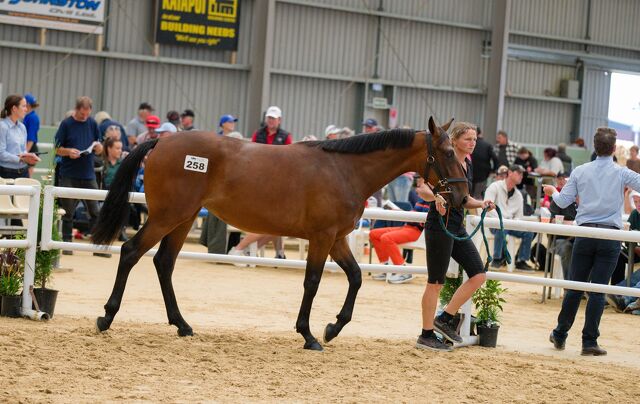
For the first time in history, trotters have aggregated more than one million dollars at a single sale, let alone nationally across the two venues, and they supplied the top lot of the entire series. The $290,000 Walner filly from Egee Money sold as Lot 258 in Christchurch not only topped the session but symbolised the shift taking place within the trotting sector.
Much of that momentum can be traced to the introduction of Stonewall Stud last year and this year the arrival of Kentuckiana Lodge to the buying bench in the trotting market. These are two of the traditional powerhouses of the pacing sale. Their entry into the trotting arena has fundamentally altered the dynamics at the top end.
Both have been open in their thinking. There are four or five trotting races carded on most programmes now. If you want to compete in them, you need stock in the barn. You cannot win those races if you do not have horses in them. That commercial logic has filtered directly into the sale ring.
Stonewall Stud topped the Christchurch buyers list with $1,355,000 spent on 13 yearlings, including the $290,000 Walner filly. Kentuckiana Lodge invested heavily as well, spending $565,000 in Christchurch and a further $519,000 in Auckland. Peter Lagan Standardbreds remained a consistent force with $650,000 in Christchurch and $445,000 in Auckland, while Barry Purdon and Scott Phelan Racing Stables led the Auckland buyers with $545,000.
The trotting lift has also been underpinned by the deliberate introduction of world class bloodlines. Pat Driscoll’s investment in elite North American and European trotting pedigrees has tipped the scales with sire lines and maternal strength rarely seen before in this part of the world. The presence of stallions such as Walner, alongside the depth offered by Father Patrick, Volstead, Orlando Vici, Tactical Landing and Timoko, has provided breeders with genuine commercial ammunition.
Walner led the trotting sires nationally with $660,000 from just three sold at an average and median of $220,000. That level of consistency at the elite end is significant. Father Patrick generated $185,000, Volstead $155,000, Orlando Vici $170,000 and Ecurie D $102,500. The depth is building without relying on one sire alone.
It will make for a fascinating dynamic long term. When these well resourced buyers begin to see their trotting investments filter through to the racetrack, the competitive landscape in that department may shift significantly.
That said, the pacing market remains the backbone of the sale.
Nationally, Captaintreacherous was the leading sire by aggregate with $2,098,500. From 21 sold he averaged just under $100,000 with a median of $90,000 and a clearance above 80 percent. His market share exceeded 21 percent of total national spend. That is authority.
Bettors Delight followed with $1,725,000 at an average of $90,789 from 19 sold. Sweet Lou was next with $1,601,500 from 29 sold at $55,224. Downbytheseaside generated $1,357,500 from 30 sold at $45,250.
Those four stallions accounted for a substantial share of the pacing aggregate. Yet there were unique sire performances deeper in the table. King Of Swing averaged $82,833 from three sold with 100 percent clearance. Bulldog Hanover averaged $65,000 from four sold. Pebble Beach averaged $58,666. Even sires with smaller representation such as Lazarus and American Ideal held solid medians relative to their averages, reinforcing buyer confidence in established lines.
In Christchurch, Bettors Delight dominated the pacing sires with $905,000 from nine sold at an average above $100,000 and a perfect clearance. Art Major was strong at $381,000 from eight sold. Always B Miki produced $268,000 from seven sold. The median for Bettors Delight sat only marginally below his average, showing a relatively even spread of value.
The price band analysis further highlights where the market is functioning best.
Nationally, 11 lots sold for $150,000 or more. Fifteen fell into the $100,000 to $149,000 range. Sixteen into the $75,000 to $99,000 bracket. Thirty three into the $50,000 to $74,000 band. The largest cohort remained the $25,000 to $49,000 group with 53 lots.
That concentration in the $25,000 to $49,000 bracket underpins the stability of the $40,000 median and confirms that the middle market continues to do the heavy lifting.
The gap between average and median remains instructive. Nationally, the overall median sat more than 27 percent below the average, reflecting the influence of the higher end on the mean. In trotters, the differential was slightly higher, demonstrating how a handful of elite prices can stretch the average without distorting the broader market.
Buyer behaviour showed both concentration and diversity.
In Christchurch, beyond Stonewall and Kentuckiana, Diamond Racing Stables invested $465,000, P I and G J Kennard Bloodstock spent $355,000 and Cullen Racing Stables committed just over $300,000. In Auckland, Solid Earth Pty Ltd made a statement purchase at $200,000 from a single lot, while Lincoln Farms Bloodstock and Team Bond added depth.
Vendor performance was equally revealing.
In Christchurch, L Smith led by aggregate with $1,652,500 from 21 sold at an average of $78,690. Renwick Farms topped the average table among vendors selling three or more at $87,417. Studholme Bloodstock Ltd achieved $704,500 from 13 sold at $54,192, while Rosedale Farm and Spreydon Lodge maintained solid clearance and consistency.
In Auckland, Breckon Farms Ltd topped the aggregate with $1,937,500 from 27 sold at $71,759. Woodlands Stud followed with $1,657,000 from 28 sold. Hollis and Robertson Equine Services stood out on average at $102,917 from six sold, highlighted by the $220,000 top lot.
Across both venues, 214 yearlings sold from 294 offered nationally. The clearance rate of just over 72 percent is solid in context, particularly with post sale negotiations still to be finalised.
The distribution between colts and fillies remains typical in pacing, with colts accounting for the majority of aggregate. In trotters, the split was more balanced at the top end, with fillies contributing meaningfully, underlined by the Walner filly who topped the entire sale.
The overarching learning from 2026 is not boom or bust. It is evolution. The middle is steady. The elite remains competitive. The trotting sector has taken another step forward without overwhelming the pacing backbone. And the presence of heavyweight buyers across both gaits reinforces that this remains a sale that serious industry participants prioritise.
The yearling sales always provide a forward looking signal. They capture breeder ambition, buyer confidence and the perceived strength of the racing programme ahead. On that score, 2026 points to a market that is adapting and recalibrating rather than retreating.
For readers seeking a deeper dive into the numbers, including a comprehensive sire by sire breakdown, clearance comparisons, median to average ratios and detailed price band statistics across both gaits, click here for an in depth analysis. The overview sheet examines aggregate by sire, market share percentages, average and median differentials, and the distribution of yearlings across each price bracket to provide a granular view of where strength and opportunity lie within the 2026 market.