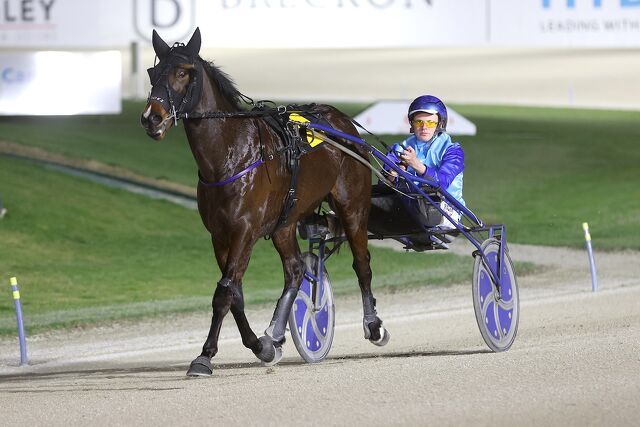
Landman: The Colt With a Stallion’s Pedigree
4 Sep 2025
The colt they call Landman announced himself at Addington with the kind of authority that turns heads and resets plans. Ben Hope rolled to the top, controlled it, and when he asked the question the two-year-old trotter simply ran away—six lengths, ears pricked—like a horse who already knows what he is.
The clock said “serious”. The manner said “there’s more”. And for co-owner and co-breeder Wayne Stewart, standing on course with his brother after promising his wife Connie he’d be there for the debut, it felt a little like a plan coming together.
“It was a hell of a thrill being down there and seeing him in the flesh,” Wayne says. “He’s a beautiful horse—lovely to handle—and Ben’s pretty excited about him. He said he just feels really, really good. You pull him out and he’s got explosive speed.”
That speed sits on top of a pedigree that would look at home anywhere in the world. Landman is by Muscle Hill—the modern benchmark—and out of Cash Lover, a six-time winner in Australia by the great Ready Cash. Under her is Lucky Love (by Love You), then All Sunny (by Sundon), and deeper into the page the famed Roydon Lodge import Roydon Gal (by Super Bowl), dam of Arndon—sire of Sundon—who shaped an era of New Zealand trotting. On paper and now to the eye, Landman is bred to be important.
Wayne never arrived at Cash Lover by accident. He had been paying attention to the Ready Cash wave long before it hit the Southern Hemisphere.
“I tried to breed to Ready Cash years ago from our good mare Quite A Moment,” he says. “I’d been following what Pat [Driscoll] was doing and believed he was on the right track. When he was talking Ready Cash and you could get semen, I was keen—but Quite A Moment didn’t get in foal.”
Fate intervened a different way. “Dave Sanders rang me out of the blue and said, ‘There’s a list of surplus horses Pat’s moving on. Have a look—there’s one I reckon you’ll want. I’m not telling you which.’ He sent the list and straight away I knew. I rang him and said, ‘Stick a hold on it.’”
The mare was Cash Lover, then an unraced three-year-old. Wayne sent respected vet Virginia Brosnan to look her over. “She came back and said: very, very small—but nothing wrong with her.” The price? “Nine thousand. You couldn’t breed one for that.”
There was domestic politics to navigate. “Connie wasn’t that keen—‘You’ve got enough horses; you’re not buying another one!’—and I was on the phone to Hopie [Greg Hope] and he goes: ‘Mate, I’ll take a half share in her.’ That’s how Greg and Nina got involved.”
Cash Lover was left in Australia to be trained by Jess Tubbs and Greg Sugars. “You could see her on YouTube—tiny wee thing. She took a long time to make a racehorse. Greg kept ringing saying, ‘She’s really slow. No speed at all. I think you’re wasting your money.’ Then one day he said, ‘She’s improving—and I don’t sack them while they’re improving.’ Next thing she’d won six or seven from a dozen. But she always had a funny action behind.”
The mystery revealed itself on x-ray. “Bone had grown over a ligament in the hock so part of it basically didn’t work. Two stress fractures in there. We could have lost her at any minute. She was retired immediately.”
Retirement didn’t mean standing still. Wayne and the Hopes bred her in Australia, reasoning that the European stallion books and series made sense and the logistics were easier. “Two reasons,” Wayne says. “There’s a lot of series over there, and it’s just as easy to have her there. Best of both worlds, really. Out of sight, out of mind a wee bit—but productive.”
The mating that mattered most was the one he’d dreamed about. “I said to Greg: ‘If we can ever get hold of Muscle Hill, that’s the guy—the ultimate cross.’ I rang Gail one day and she said, ‘Yes, there’s some Muscle Hill there.’”
From such decisions colts like Landman are made. The next call was where to raise and train him. “Greg already had a half share in the mare, and I knew how dedicated that family is,” Wayne says. “If you’re ever going to potentially make a stallion, having the trainer own a share means they’re naturally invested in every detail—not to say others wouldn’t be—but it gives you confidence the extra one percent will always be there.”
Landman crossed the Tasman as a baby—“I think he came as a weanling”—and grew up under the Hopes’ patient system. Wayne got the occasional wheel-time on stable trips. “Hopie always gets you to jump in the cart—bit of free labour—but I love it. He took Landman down the beach and trotted him alongside us. Geez, he was a nice-going horse. Greg said: ‘He’s lovely—he’s got a motor, got speed. We’ll just take our time.’”
The public saw the hints in trial times. Wayne and the camp saw enough to be confident when the gate folded at Addington. “Greg told me the only thing that might beat him first-up would be greenness—first night at the races—because ability-wise it wouldn’t be an issue. With baby trotters you never quite know, but we were hopeful.”
Hope became proof. The result also came with a practical sugar-hit: Entain’s $15,000 2YO Bonus. “It costs a lot of money,” Wayne says, frank about the economics. “But if you spend the money and put the best to the best, you hope for the best—and one day you might get it.” The bonus helps offset the long logistics of importing and educating a colt like Landman; the pedigree and performance are what make the numbers add up.
What happens next will be shaped by Greg and Ben, but there is a clear short-term map. “I think they’re thinking definitely next weekend,” Wayne says. “Then the $50,000 race at the end of the month.” The $50,000 race in question is The Sundon 2YO Mobile Trot (Group Three), where Landman will likely clash with the unbeaten filly Duchess Maria (Father Patrick). Beyond that, Australia is very much in the frame. “He’s paid up for Vicbred and I paid him for Breeders Crown the other day. If he went really good next week and then was stiff in the $50,000, he’ll probably go to Australia.”
Closer to home there’s the perennial Sires’ Stakes question and the complication that Muscle Hill may not have been nominated as a stallion in New Zealand the relevant year. “My understanding is he wasn’t,” Wayne says. “If so, there’s a stallion fee involved. We’ll talk to the right people and see what it takes.” The way the colt won, he’d be favourite in any local futures market that would frame one.
It’s impossible to talk about Landman without talking about leaving him entire. New Zealand has a habit of gelding its blue-blood trotting colts—sometimes for manageability, sometimes out of system inertia—and history shows many Muscle Hill sons here never got the chance to test the stallion lane. Wayne understands the trade-offs.
“Ben joked, ‘Right, let’s retire him now—he’s unbeaten!’ Greg said he’d probably be a lot better if we cut him. Longevity-wise, geldings often go on longer, and I’m not saying he won’t go on as a colt. But traditionally, colts and stallions don’t race for as long.”
Meanwhile, Cash Lover’s story continues. The next foal from her was a filly who nearly didn’t make it. “She got really badly hurt as a baby—no idea how—and developed a nasty infection in a front fetlock. They couldn’t grow a culture; thought it might be some sort of superbug. We spent a lot and at one point they said, ‘We might have to put her down.’ I told them, ‘I can’t just breed another one—save her for me as a broodmare.’ They flushed and did all sorts, and they saved her. She’s broken in now and trotting around for Brent Lilley—you wouldn’t even know. Whether it catches up with her later, I don’t know, but she’s going.”
Cash Lover herself is booked back to Muscle Hill this season. The numbers are significant for any breeder seeking access to elite blood, but the reasoning is simple: the cross works, and the page sells itself.
Wayne tracks the European stallions with the zeal of a student. He admires Face Time Bourbon—“probably the best Ready Cash son”—and he keeps an eye on Australasian supply-demand dynamics. For sellers, being “one of one” or “one of a few” in a catalogue matters—especially in a trotting market that, at the top end, isn’t yet as buoyant as the pacing side. It can make all the difference between testing a premium and being lost among similar lots.
The Hopes—Greg and Ben—know how to get the best out of budding champions; they’ve done so with the likes of Monbet, Quite A Moment and Muscle Mountain, to name a few. They also know the local incentives and series well enough to map a colt’s education around them. What they can’t control are stakes and status. The industry debate around showpiece trotting races is real.
As I’ve argued elsewhere, there’s no good reason the Dominion should sit so far behind the Cup. Wayne’s on board with the sentiment and adds the practical imperative: “We should be beating the drum harder.”
For Wayne and Connie, this all feeds into why they chose to lean into trotters years ago. “It’s very hard to breed a really good pacer—there are so many of them and the blood’s all the same. Unless you’re in the right barn, you’re not winning the big pacing races. We thought we’d concentrate on something we might have a real go at—see where it takes us.”
Where it’s taken them, for now, is back to Addington next weekend, then to The Sundon 2YO Mobile Trot at month’s end, and maybe across the Tasman for springtime learning in the heat of Vicbred and Breeders Crown. It’s also taken Wayne back to the rail, back to the reason you pay the bills.
“I’m 64 now, working my arse off farming. It’s time I sold some assets and enjoyed my horses. I hardly ever watch them live—usually on TV or replays. But being there the other night, seeing him do that was special. When this boy lined up for his first start, I said I’d be there. He’s been a long time in the making.”
A long time in the making, and built the right way: top to bottom, Muscle Hill over Ready Cash over Love You over Sundon, a maternal family that speaks both sides of the world, and a motor that already talks for itself. The name fits: Landman, the colt who might just redraw the map.